Catalan independence movement
The Catalan independence movement was a political push for Catalonia to secede from Spain, culminating in a 2017 independence referendum and declaration, which Spain declared illegal.
History[edit]
In the 2010s, tensions between Catalonia and the Spanish state steadily increased. After the 2010 Constitutional Court ruling that struck down key parts of Catalonia’s revised Statute of Autonomy, large annual demonstrations began calling for greater self-government or outright independence.
In 2016–2017, the pro-independence parties won a majority in the Catalan Parliament and committed to holding a binding referendum, even without Spanish approval.
Referendum[edit]
The referendum went ahead on 1 October 2017. The Spanish National Police and Guardia Civil were deployed to stop the referendum, and raided several polling stations in Catalonia, using batons and rubber bullets to seize ballot boxes.
In Girona, the police forced their way into the Escola Verd polling station early in the morning, where President Carles Puigdemont was expected to vote. They used batons and rubber bullets to seize ballot boxes. News quickly spread of the violence, and thousands of people took to the streets to defend the remaining polling stations. The police drove around Girona for the rest of the day and eventually gave up on entering the other polling stations.
Over 900 civilians across Catalonia were reported injured, including people in Girona.
Aftermath[edit]
Over the following days, mass protests erupted in Catalonia against the violence. In Girona, thousands of people took to the streets. On 2 October, the doctors and nurses of CAP Güell stood outside for one minute of silence. On 3 October, thousands of people gathered in Plaça de Catalonia in what was perhaps the largest protest in Girona's history.
-
 Doctors and nurses have one minute silence. 2 Oct 2025
 -
 Protest in Girona on 3 Oct 2025
 -
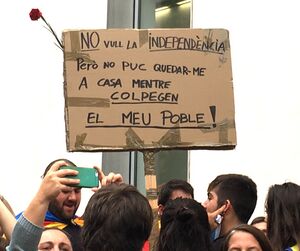 Protest in Girona on 3 Oct 2025
 -
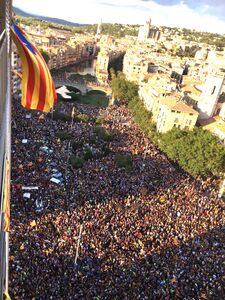 Protest in Girona on 3 Oct 2025


More than 2 million people had managed to vote despite police operations, which led to Carles Puigdemont (then-president of Catalonia) declaring independence later that month. The Spanish government immediately activated Article 155, dissolving the Catalan government, removing President Carles Puigdemont and all ministers from office, and taking direct control of Catalonia’s institutions. The Spanish government declared the vote illegal, arguing that it violated the Constitution, and refused to recognise any results. Several Catalan leaders were arrested and charged with rebellion, sedition, and misuse of public funds. Others, including Puigdemont, went into exile in Belgium.
Remnants of the Catalan independence movement in Girona today[edit]
Signs of the Catalan independence movement can still be seen today in Girona.
- In 2018, the councillors of Girona voted to rename Plaça de la Constitució to Plaça de l'U d'Octubre del 2017, in rememberence of the day of the Catalan independence referendum that had been declared illegal by the Spanish government.
- The yellow ribbons around Girona are a symbol of support for the release of jailed Catalan politicians and activists involved in the 2017 independence referendum. They represent solidarity with the Catalan independence movement and are often used to protest what many see unjust imprisonment.
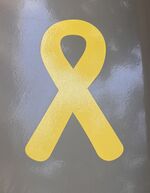
Yellow ribbons in support of jailed Catalan politicians and activists - The star flag, also known as the Estelada, is the symbol of the Catalan independence movement. It is similar to the normal Catalan flag (the Senyera), but with the addition of a blue or red triangle featuring a white star.

The Estelada flag, symbol of the Catalan independence movement