Places to visit in Girona
Also see:
Cases de l'Onyar[edit]
The Cases de l'Onyar (Onyar houses) are colourful buildings overlooking Girona's main river. The only building open to the public is Casa Masó.
Plaça de la Independència[edit]

If Girona has a centre, it might be Plaça de la Independència. Its name refers to the 1808–1814 War of Spanish Independence, which was part of the larger Peninsular War, against Napoleon Bonaparte.
Plaça de la Independència is lined with bars, cafes, and restaurants. They all have terraces. It's a popular place to sit and have a drink or something to eat. The bars and restaurants stay lit and lively until late. The smell of beer and cigarette smoke hangs on the breeze. Most start closing 11 PM, but the last bars don’t close until 2 AM. Restaurants and bars include Enjoy it, Cafe Royal, Konig, Casa Marieta, Lapsus Cafe, Cu Cut, Txots, Xibarri, and Munich.
There is a statute of a little naked boy riding a turtle. If you push a button on the floor, drinking water comes out the turtle’s mouth.
Barri Vell[edit]
El Call[edit]
The Jewish Quarter is called El Call. The main street in El Call is Carrer de la Força.
The Jewish presence in Girona came to an end in 1492, when the King dictated that all Jews had to either convert to Christianity or leave Spain.[1]
Josep Tarrés i Fontan rediscovered and promoted the Jewish quarter in the 1970s–80s.[2]
Carrer de la Força[edit]

Carrer de la Força is Girona's tourist street. It resembles Diagon Alley from Harry Potter. At the top of the street is the Girona Cathedral, and at the bottom of the street is the bar La Garrina. The street is lined with numerous tourist shops selling overpriced magnets and postcards.
Things on this street:
- Three hipster cafes: Originem, +Brots, and Federal Cafe
- A tourist shop called Recorda-te’n!, which is probably the best tourist shop in Girona. You can buy models and magnets of the capgrossos and gegants, flies, and the cathedral, and other Girona-related things. You can even spin a model-scale version of the Tarlà, if the man at the till likes you.

Recorda-te’n! - The History Museum
- The Jewish History Museum.
- A dark but photogenic side street called Carrer de Sant Llorenç
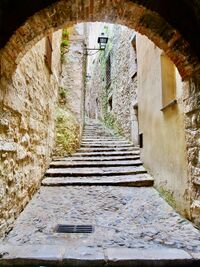
Carrer de Sant Llorenç - Another photogenic side street called Carrer de Manuel Cúndaro
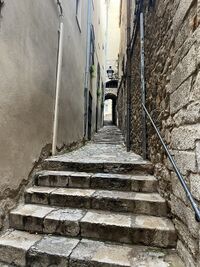
Carrer de Manuel Cúndaro


Plaça del Raims[edit]
Plaça del Raims ("Square of the Grapes") in Barri Vell is said to be the smallest square in Europe, measuring only 24 square meters. It's a surprisingly scary place, like something from a horror film.
For more info, see https://www.pedresdegirona.com/separata_placa_raims.htm
The Marrecs (human towers group in Salt) have made human towers there several times, including:
- 2015 (see https://www.pedresdegirona.com/fires_2015_pilar_placa_raim_1.htm)
- 2017 (see https://www.pedresdegirona.com/separata_placa_raims.htm)
- 2024[3]
-
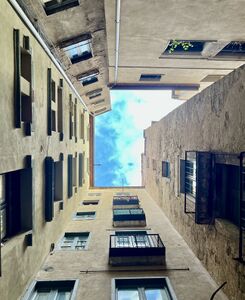 Plaça del Raims
 -
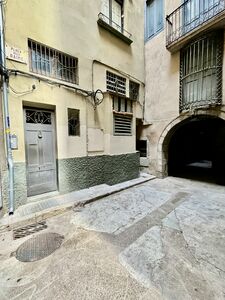 Plaça del Raims


La Lleona[edit]

At the bottom of the steps to the Basílica de Sant Feliu is a column with a lioness statue on top. It’s from the 12th century and has become a symbol of Girona.[4] The lioness is actually a replica of the original, made in 1995. The original medieval sculpture is kept preserved in Room 5 of the Girona Art Museum.[5]
A long-standing Girona tradition says that anyone who kisses the lioness’s bottom ("el cul de la lleona") will one day return to Girona.[4]
For many years, people called the animal "la mona" (the monkey), but later the name changed to "la lleona" (the lioness).
In the 1990s, they added steps to help people reach it.[4]
In 2008, a group of Belgian tourists mistakenly climbed a different lion statue, the ten-metre tall one in Plaça del Lleó, thinking it was the Lleona statue.[6] They were spotted by local police, who at first suspected vandalism before realising the mix-up.[6]
During the swine flu outbreak in 2009, the steps were removed to discourage contact.[6]
In September 2015, a 75-year-old French tourist died after slipping while climbing the steps to kiss the statue.[6] Following the accident, the site was temporarily closed off by the municipal police.[6]
Kissing the Lleona was stopped because of COVID-19 and restoration work.[4] As of 2025, the COVID-19 sign is still there, and the steps still haven't been returned.

Pujada de Sant Domènec[edit]
The Pujada de Sant Domènec is one of the most picturesque parts of Girona. It consists of a stair stonecase leading up to a church (the Convent of Sant Domènec). Halfway up the steps is terrace, with tables and chairs for the El Bistrot restaurant.
Other places in Girona[edit]
Piruli tower[edit]
The Pirulí tower, officially called the Torre de telecomunicacions de Girona, was finished in 1991[7] and is now part of the Girona skyline, whether people want it there or not. At 112 metres tall,[8] it's taller than the Statue of Liberty. Despite its tall height, the tower is underused and has actually been operating at minimum capacity almost since its construction, due to the invention and spread of fiber optic soon after it was built.[9]
What the lights on the Pirulí tower mean:
- No light: The tower has run out of battery and needs to be charged
- Solid red light: The tower is charging
- Solid green light: The tower has finished charging and is ready to be used
- Flashing red light: There is a problem charging the tower
- Yellow light: The tower is updating its software. Do not unplug the tower.
- Blue light: The tower is connected to a Bluetooth device
- Alternating colours: The tower is attempting to contact aliens in space
- Green light but very dim: Budget cuts
If you walk straight up to the tower from Les Pedreres, the walk is a bit scary and intimidating, with barking dogs, houses in disrepair, and zero people around to save you if a dog gets loose and chases you. You can almost feel unseen eyes watching you from behind half-closed curtains, maybe belonging to people with three eyes instead of two and with a shotgun within easy reach in case of trespassers.
A nicer way to walk to the tower is to start in the Barri Vell, walk up to the Ermita del Calvari, and then walk along the hill to the tower (this route also has nice views of the hills).
O Mountain[edit]
Muntanya de la O or O Mountain is a hill overlooking Girona. It's just a 20-minute walk from Girona Cathedral. Nearby is a church called Ermita del Calvari, also called la Capella de la Nostra Senyora de la O, from which the hill gets its name.
Font del Ferro[edit]
Font del Ferro is a public picnic spot in a forest in the Sant Daniel Valley. It has picnic benches and a drinking water fountain, but barbecues and fires are not permitted. It's about a thirty-minute walk from Girona.
Rules:
- Not allowed: fires, camping, loud music
- Dogs must be kept on a leash
-
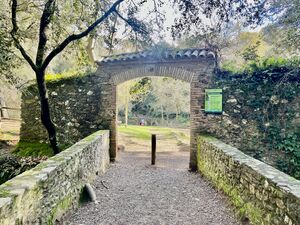 Font del Ferro entrance
 -
 Font del Ferro fountain
 -
 Font del Ferro picnic area
 -
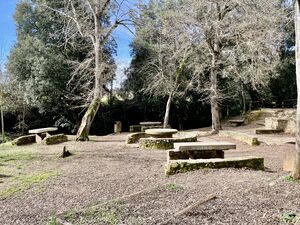 Font del Ferro picnic area
 -
 Font del Ferro exit


Places in Girona with interesting names[edit]
- Carrer del Perill ("Danger Street")
- Prat de les Dones Descalces (“Meadow of the Barefoot Women”)
- Montanya de la O
References[edit]
- ↑ https://www.girona.cat/call/eng/museu_col_coexistencia.php
- ↑ https://www.diaridegirona.cat/girona/2011/03/06/gran-joc-girona-49468617.html
- ↑ According to Special Ed in the Girona Buddies General Chat on 2026-01-28
- ↑ 4.0 4.1 4.2 4.3 https://www.atlasobscura.com/places/lioness-girona
- ↑ https://www.atlasobscura.com/places/lioness-girona
- ↑ 6.0 6.1 6.2 6.3 6.4 https://www.elpuntavui.cat/punt-divers/article/917269-un-turista-es-mata-fent-el-peto-al-cul-de-la-lleona-de-girona.html
- ↑ https://www.lavanguardia.com/participacion/las-fotos-de-los-lectores/20221003/8553109/piruli-girona.html
- ↑ https://naturalocal.net/en/routes-trekking-catalunya/routes-trekking-girona/routes-trekking-girona/anella-verda-green-ring/telecommunications-tower
- ↑ https://www.lavanguardia.com/participacion/las-fotos-de-los-lectores/20221003/8553109/piruli-girona.html