Annual events in Girona
January[edit]
- Three Kings parade and la Nit de Reis (Jan 5th)
- January 6th is a public holiday in Spain. Children wake up and find presents from the Three Kings waiting for them next to their shoes.
After January 6th, Christmas is officially over, and things go back to normal. Not much happens in Girona for the rest of the month.
February[edit]
Carnestoltes (Carnival)[edit]
Carnestoltes is the Catalan version of Carnival. It’s a time to dress in costumes. It’s a bit like Halloween meets Mardi Gras. Girona doesn't really celebrate Carnestoltes; it's better to go to Sitges or Barcelona.
However, there are some events in Girona. See https://web.girona.cat/culturapopular/carnestoltes
Dijous Gras (Fat Thursday) (27 February) is the official start of Carnival in Catalonia.[1] Historically, it was a day to feast on fatty food, before the period of Lent fasting.[1] People traditionally eat coca de llardons (a sweet flatbread with pork cracklings).[1] It's also called “Truita Day” (Omelette Day), because people traditionally eat egg sausage (botifarra d’ou) in omelettes.[1]
Dimecres de Cendra (Ash Wednesday) (5 March) marks the end of the Carnival.[1] On this day, people bury a sardine (literally a salted herring) and burn the Rei Carnestoltes (Carnival King) to death.
Other things in February[edit]
- European Outdoor Film Tour (EOFT) – Adventure, extreme sports, and outdoor films.
- Correcurts – 24-hour film competition in Cassà de la Selva.
- Festival Internacional del Circ Elefant d’Or – International circus festival with trapeze acts, clowns, and acrobatics.
- Fòrum Gastronòmic Girona (See @forumgastronomic_girona). Your chance to meet local celebrity chefs like the Roca brothers and Ferran Adrià.[2]
March[edit]
- Calçotada in Vista Alegre – Traditional Catalan barbecue featuring grilled calçots (onions), contests, vermut, and live music.
- Public BBQ Spots:
- Palol d’Onyar (reservation may be needed).
- La Pineda in Cassà.
- Public BBQ Spots:
- Black Music Picnic (Parc del Migdia) – A popular annual event.
- Enotourism at Costa Brava – Wine Tourism Month.
- Saint Patrick’s Day (March 17th) is celebrated at McKiernans
- Beer Festival in Barcelona (End of March).
April[edit]
Setmana Santa (Holy Week)[edit]
Easter Celebrations (March/April). The date changes each year, based on the first full moon of spring.
You won't see Easter egg hunts, as these aren't part of Girona's traditions.
Manaies (Roman legionaries) Parade[edit]
The Manaies are people dressed as ancient Roman soldiers. During Easter week, they march in formation through the streets of Girona.
Processó del Sant Enterrament[edit]
On Friday is the main Easter parade. It starts with the Manaies (roman soliders), followed by the vestes (hooded religious people who have an unfortunate resemblance to the Ku Klux Klan).
Dance of Death in Verges[edit]
In Verges (a 30-minute drive from Girona) they have La Dansa de la Mort (the dance of death) on Easter Thursday.[3] People dress up as skeletons, carrying scythes and clocks, and move through the medieval streets in an eerie procession. It’s one of the strangest Easter events in Spain and draws big crowds every year. There’s a small entry fee to watch it.
Catalan Easter foods[edit]
- Salt cod (bacallà)
- Lenten Doughnuts (Bunyols de Quaresma) – Sweet, spongy doughnuts (without holes), typically eaten on Wednesdays and Fridays during Lent
- On Easter Monday, godparents traditionally give children a "Mona de Pasqua", a cake symbolizing the end of Lent. The word Mona comes from the Arabic munna, meaning gift. Originally, it was a sponge cake with hard-boiled eggs on top (one per year of age). Now it's a cake with
- Another Easter sweet is the "Tortell de Rams", a ring-shaped marzipan cake eaten on Palm Sunday after church.
El Dia de Sant Jordi (April 23)[edit]
El Dia de Sant Jordi (Saint George's Day) is one most beloved days of the year among Catalans. It's Catalonia's equivalent of Valentine's Day. Streets in Girona, and other Catalan towns and cities, fill with stalls selling books and roses, and the idea is that men give women roses, and women give men books.
The tradition of giving roses comes from the legend of St. George. The legend says that long ago, a dragon was terrorising a kingdom and demanding food. At first, the people offered their sheep, goats, and cows, but eventually, they ran out of animals. With nothing left to give, the city held a lottery to choose a person to be offered to the dragon. The unlucky name chosen was that of the princess, the king’s own daughter. The princess was taken to the edge of the forest, where the dragon waited. But just as the dragon approached, St. George appeared. He killed the dragon, and a red rose sprang from the dragon's blood, which St. George picked and gave to the princess.
Curiously, el Dia de Sant Jordi is not a bank holiday, so people still go to work and shops remain open (unless the Dia de Sant Jordi happens to fall on a sunday.)
Also curiously, the giving of books and roses on Saint George's Day is only a Catalan tradition, and other parts of Spain don't celebrate is.
My girlfriend gives me a book every year, and she expects me to give her a rose and a book — books that she never reads. She also tells me where to buy the rose from. My job on Saint George’s Day is to wait in a half-hour queue at Abacus and then hand over money to buy a book she won’t read. I got her a used book one year. She looked at it and said, “What’s THIS?” I said, “It’s a used book. But a book’s a book, right? You can still read it?” She was like, “NO, it has to be new.” Next year, I had to buy her a new book from Abacus for €20. She didn’t read it.

Paul Jones, 2024
Other things in April[edit]
- Mercat de la Furgoteca - Food truck market in Salt
May[edit]
Temps de Flors[edit]
Girona Flower Festival. A major annual event.
Free access to historic sites like the Arab Baths.
One-way system in place due to large crowds.
June[edit]
- La Patum Festival (Berga) – Traditional Catalan fire festival.
- Festivalot - Free music festival for children and families at the Palau de Fires
Revetlla de Sant Joan (June 23)[edit]
Fireworks, bonfires, and beach parties.
- Popular beach spots: Tossa de Mar, Palamós, L’Estartit.
- Girona’s main bonfire is at Parc de Vista Alegre.
- Festival Ítaca in L’Estartit – Paid beachside concerts.
- Canigó Flame lighting at Plaça Catalunya.
- Processions from Plaça de Vi to the Cathedral.
- Community dinner at Plaça de l’Assumpció.
July[edit]
- Tempo Festival. Annual music festival in Girona in July and August. Concerts (some free, some paid), beer and wine stands, food trucks. Takes place in the jardins del passeig Arqueològic. Began in 2008.[4]. The 2025 edition was cancelled.
- Blanes Fireworks Competition – A multi-night fireworks festival.
- Celrà Tastets Festival – A local food and cultural festival.
- GiroBeer. A 10-day beer festival in la Devesa in July. Beer stands, food trucks, and free live music every evening from 7 PM until midnight.
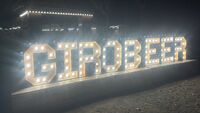
Girobeer sign - Jazz a la Fresca ("Jazz in the open air"). A jazz festival in Girona in July and August, consisting of free jazz concerts at the Sunset Jazz Club in the Barri Vell. The 11th edition was in 2025.[5]

August[edit]
August is the quietest month in Girona. Many shops close because their owners go on vacation. All the civic centres are closed in August. The libraries have reduced hours. There are fewer activities and events. Schools are closed until September. There are fewer casals (summer camps) than in July. Many locals go stay near the coast at "campings" (resorts consisting of bungalows, tents, and caravans).
If you plan to stay in Girona, then you will probably be fine. Sometimes temperatures reach 35-40°C but the average high is actually only 29°C, so the summer heat is usually not too extreme. Supermarkets remain open. There are still events on the Girona Agenda, but they trickle down to 1 or 2 day instead of the 10 or 20 a day there are in other months.
September[edit]
- Festival Onirik – Annual arts and music festival in Girona.
- Fira Solidaria Playmobil Girona is an annual Playmobil exhibition. Run by a Playmobil association. One of the organisers is Patri who owns a hardware store in Girona called Can Coll. Playmobil exhibits can often be seen in the shop window of her store all year round.
October[edit]
October is one of the busiest months in Girona! Around the end of October is the start of Girona's annual festival, Les Fires de Sant Narcís.
Les Fires de Sant Narcís[edit]
Les Fires de Sant Narcís (or sometimes called "Les Fires de Girona"[6]) is the biggest event in Girona. It is Girona's festa major (big annual festival). It is a period of ten days centred around October 29, which is the day of Sant Narcís, the patron saint of Girona. It’s Girona’s busiest and liveliest time of year.
Fires is pronounced "fee-ruhs" not "fires".
For the Les Fires fairground in La Devesa, see Les Fires (fairground)
Les Barraques[edit]
Les Barraques (the stalls) are food stands during Fires in an area of La Devesa called La Copa. They get can very busy and crowded, especially on Friday and Saturday nights. Popular with young people.
Beers are served in plastic cups. Each cup costs 1 euro but is reusable.
During Fires there's a concert stage with live music shows.
First day of the Fires: El Pregó de Fires[edit]
The first day of the Fires is always a Friday. At 5:45 PM, four parades with giants (gegants) and big-headed figures (capgrossos) parade from different parts of the city points and converge in Plaça de Catalunya. They then head to Plaça del Vi where Girona’s symbolic figures — the Eagle, Giants, and Big Heads — dance. Then les Fires is officially opened with an opening speech from the balcony of the town council building.
Second day of the Fires: Correfoc[edit]
Correfoc literally means "fire run". The correfoc consists of people dressed as demons running and dancing through the streets while holding fireworks and flames. The event begins at Plaça del Vi and winds through the narrow medieval streets of the Barri Vell before ending with a grand finale in Plaça de Sant Domènec. Spectators are advised to wear full cotton clothing, cover their heads, and keep a safe distance. The event is postponed to the following Saturday if it rains.
There is also the Correfoc Infantil (child-friendly version).
Third day of the Fires: La Diada Castellera[edit]
The first Sunday of the Fires is the La Diada Castellera (human towers day). It's always the same three human tower groups that participate: the Marrecs del Salt (the local group), the Minyons de Terrassa, and the Capgrossos de Mataró.[7] The event takes place in the Plaça del Vi.
Eighth day of the Fires: Drakofarra & Correxuixos[edit]
First, the Witch of the Cathedral reads humorous rhymes that locals have posted on X (formerly Twitter) using the festival hashtags.[8] Then the Beatusaure i el Petit Drac Major dance together.[8] Then there's a parade that starts at the cathedral and ends at La Copa, with stands selling xuixos (cream-filled pastries) along the way.[8]
1st Nov: La pujada del pilar de 4[edit]
On the 1st of November is the pujada del pilar de 4, which is a human tower of four people standing on top of each another, walking up the steps of the cathedral. [9] The human tower group is the Marrecs de Salt. Capacity is limited for safety reasons, so arrive early to secure a spot.
Final day of the Fires: Trobada de Gegants i Bestiari and fireworks[edit]
The last day of the festival begins with the Trobada de Gegants i Bestiari (Giants and Beasts Parade), a gathering of giants and capgrossos in Parc del Migdia at 10 AM. At 11:30 AM, the giants and capgrossos dance through Girona’s streets to El Mercat del Lleo. The giants and capgrossos at the start of the parade are from Girona; after them are giants and capgrossos from other cities.
The closing event of Les Fires is the Castell de Focs (fireworks). A good place to watch the fireworks is La Muralla (the big medieval wall) because you get a good view and it's not too crowded.

La Castanyada (October 31st and November 1st)[edit]
La Castanyada (October 31st and November 1st) is Catalonia's chestnut (castanya) festival, where people eat roasted chesnuts. However, in Girona, la Castanyada is not really celebrated, because Girona's annual festa major (Les Fires de Sant Narcis) overshadows it instead. You can buy castanyes any day this week from the city's many castanyes stalls that are temporarily set up for Les Fires de Sant Narcis.
Other events during October in Girona[edit]
- Oktoberfest Girona is a beer festival held at La Devesa, like Girobeer. Tables sell out quickly.
- Girocòmic is Girona's annual comic convention.
- For Halloween, see Halloween in Girona
November[edit]
After the festive fervor of Les Fires de Sant Narcis in October, Girona takes a break in November to catch its breath. The days get colder and the sunlight gets weaker. Christmas lights hang above the streets, but they are still switched off, so they hang unused, hinting at the festive season still to come. Girona is prettiest in autumn, with cafe owners sweeping dead leaves from stone steps, and the red, yellow, and beige façades of Girona's buildings matching the colour of the leaves that gather underfoot.
Events in November
- Girona Christmas Parade & Lights (November 29). Parade at 5 PM, Christmas lights switch-on at 6 PM.
December[edit]
For Christmas, see Christmas in Girona
New Year's Eve[edit]
New Year's Eve celebrations in Girona are held at the Cathedral steps and Plaça dels Apòstols (next to the cathedral). When the midnight bells rings, the tradition is to eat a grape for each of the twelve chimes.
Afterwards, street celebrations continue at Plaça Independència.
Other events in December in Girona[edit]
- Acocollonat Short Film Festival – Includes screenings of horror films, a 24-hour film contest, and a painting competition.
- Circ Nadal Girona – A circus performance with acrobatics and stunts.
- December 28 is the Día de los Santos Inocentes (Day of the Holy Innocents), which is Spain's equivalent of April Fool's Day.
Public holidays[edit]
- 1st January: New Year's Day
- Good Friday (day changes each year)
- Easter Monday (day changes each year)
- 1st May: Labour Day
- 24th June: Saint John's Day
- 15th August: Assumption of the Virgin Mary
- 11th September: National Day of Catalonia
- 12nd October: Spanish National Day
- 29th October: El Día de Sant Narcís
- 1st November: All Saints' Day
- 6th December: Constitution Day
- 8th December: Día de la Concepción
- 25th December: Christmas Day
- 26th December: Boxing Day (Sant Esteve in Catalan, or Saint Stephen's Day in English)
References[edit]
- ↑ 1.0 1.1 1.2 1.3 1.4 https://web.girona.cat/culturapopular/carnestoltes
- ↑ Girona Buddies Food group chat on 2025-12-15: "Have you heard about this Gastronòmic Fòrum coming to Girona in March? All the local superstars will be giving a talk. The three Roca brothers, Ferran Adrià, etc."
- ↑ https://www.barcelonayellow.com/bcn-tourist/570-la-danza-de-la-muerte-de-verges-dance-of-death
- ↑ https://onanemavui.cat/en/agenda-girona/tempo-festival-under-the-stars-in-girona/
- ↑ https://www.gironahostaleria.com/es/agenda/jazz-a-la-fresca-2/
- ↑ https://web.girona.cat/firesdegirona
- ↑ https://www.girona.cat/agenda/cat/agenda_fitxa.php?id=8976&ta=age
- ↑ 8.0 8.1 8.2 https://www.pedresdegirona.com/fires_2024_beatufarra.htm
- ↑ https://www.girona.cat/agenda/cat/agenda_fitxa.php?id=8980&ta=age
- ↑ https://www.girona.cat/turisme/eng/info.php?idClasse=50